

how long does creatine take to work: Timeline & Tips
So, how long does it actually take for creatine to start working? The short answer is you can feel a performance bump within the first week, but the visible strength and muscle gains everyone talks about? Those usually show up after about 4–6 weeks of consistent daily use.
Your Creatine Results Timeline Explained
Let's break down what's happening in your body from the moment you start. It’s not an overnight switch, but a gradual process of topping off your muscle's fuel tanks.
Here’s what you can realistically expect, week by week:
- Week 1: You might notice the number on the scale tick up slightly. This isn't fat—it's your muscles pulling in extra water, which is the first sign the creatine is getting to work. Your muscles will look and feel a bit fuller.
- Week 2: This is when you start to feel it in the gym. You might squeeze out an extra rep or two on your heavy lifts or feel more explosive during sprints as your muscle's energy stores climb.
- Weeks 4–6: Now we're talking. With your muscles fully saturated with phosphocreatine, you'll see noticeable gains in strength and size. This is the payoff for your consistency.
This infographic gives you a quick visual of what’s happening and when.
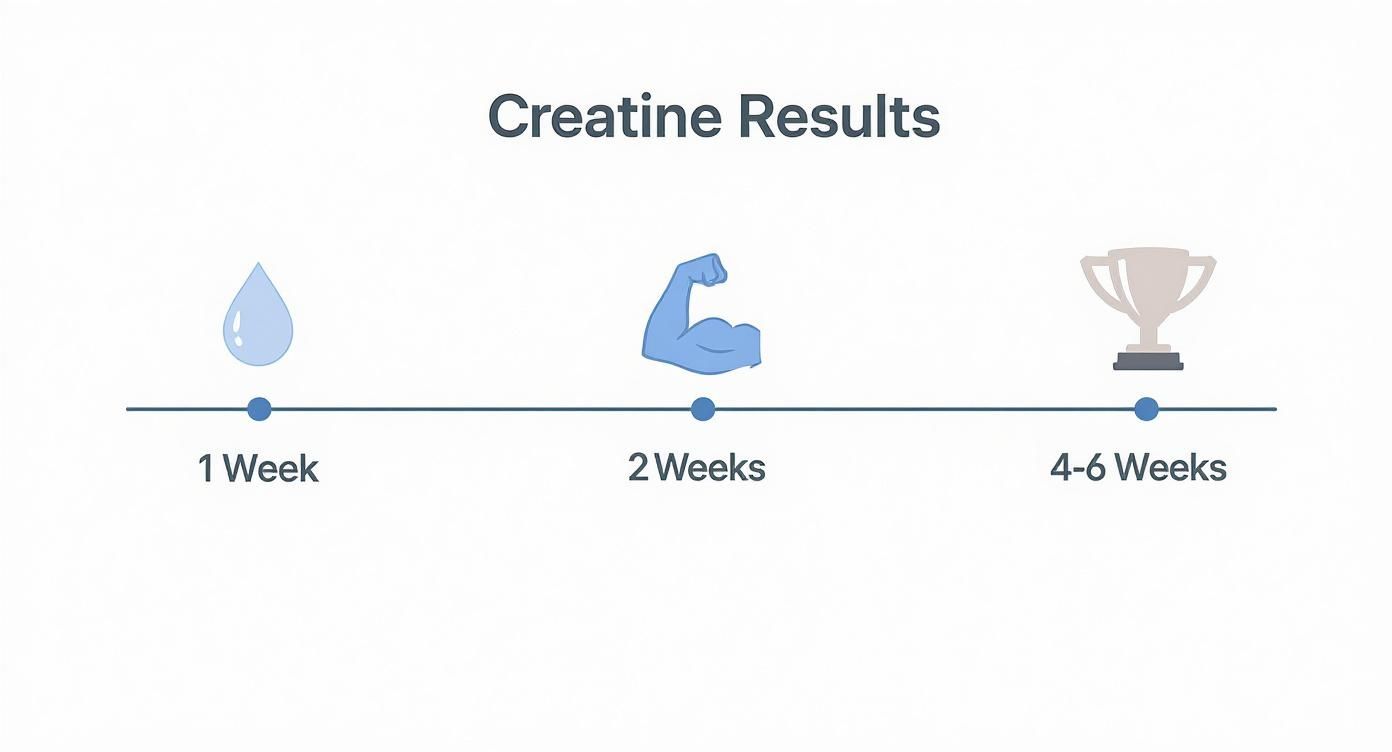
The key takeaway is that you're building momentum. The first week is about hydration, week two brings a power boost, and weeks four to six are when the real muscle-building results start to show.
If you decide to do a "loading phase," you can speed things up. Research published on Transparent Labs shows that loading can increase muscle creatine content by 20% to 40% in just 5–7 days. Without loading, it can take 3–4 weeks to hit those same levels with a lower daily dose.
Expected Creatine Results Timeline
To make it even clearer, here’s a simple table mapping out what to expect. Think of it as your creatine roadmap.
| Timeframe | Primary Effect | What's Happening in Your Body |
|---|---|---|
| 1 Week | Water Retention | Your muscles are pulling in extra fluid as their phosphocreatine stores begin to fill up. This gives you a "fuller" look. |
| 2 Weeks | Performance Boost | Your body's ability to quickly regenerate ATP (energy) improves, letting you push harder during intense sets. |
| 4–6 Weeks | Strength & Muscle Gain | Sustained energy availability allows you to train harder, which signals your muscles to adapt and grow over time. |
This timeline helps you know what to look for and when, so you don't get discouraged if you're not lifting cars by day three.
"Initial strength gains often come from your energy stores refilling. True muscle growth is what follows."
Knowing what's happening behind the scenes helps you stay patient and trust the process.
Tips To Maximize Early Gains
Want to make sure you get the most out of those first few weeks? Here are a few non-negotiables:
- Load Correctly (If You Choose To): Taking 20 grams per day, split into four 5-gram doses, is the fastest way to top off your muscles.
- Stay Hydrated: Creatine pulls water into your muscles, so you need to drink more of it. Aim for at least 8 glasses of water daily, maybe more.
- Pair with Resistance Training: Creatine provides the fuel, but lifting is what tells your body to use that fuel to build muscle. Be consistent with your workouts.
- Drop to a Maintenance Dose: After the first week (especially if you loaded), switch to a daily dose of 3–5 grams to keep your muscle stores saturated without any potential digestive issues.
Whether you load or just start with a daily dose, consistency is everything. Align your supplement routine with your training, and you'll hit every milestone right on schedule.
And as always, if you have any medical concerns or questions, it's a good idea to chat with a qualified health professional before starting something new.
The Science Behind Muscle Saturation

Think of your muscle cells like tiny smartphone batteries. Before creatine, they might be at 60% charge—enough to get by, but they’ll die when you need them most. Creatine acts like a fast-charging power bank, filling those cells to 100% capacity.
This stored energy is called phosphocreatine, and it’s your muscles' secret weapon for powering through those last few tough reps. When your primary energy source (ATP) runs out mid-set, fatigue hits hard. You’re forced to stop, rest longer, and your progress stalls.
Fully "saturated" muscles, on the other hand, have a deep reservoir of phosphocreatine ready to go. They can rapidly recharge ATP, letting you push harder for longer. This is the foundation of how creatine works—it starts by filling up the tank.
Understanding the Power Bank Analogy
It’s a simple but powerful idea. Your phone's about to die during an important call, so you plug in a power bank for an instant boost. Creatine does the same for your muscles during a heavy lift, letting them perform when they’d normally give up.
Here’s what that means for your workouts:
- Deeper Energy Reserves: Your muscles have more readily available fuel to regenerate ATP.
- Quick Recharge: Instead of waiting, your muscles can replenish energy in seconds.
- Sustained Power: Fully charged muscles don't fatigue as quickly, so you can maintain force and intensity.
This is why you don't feel a massive strength surge after just one scoop. The real magic happens once your muscles are fully saturated.
How to Fill Your Muscle’s Battery
You have two main paths to get your muscles fully saturated, and both work great. It just comes down to how fast you want to get there.
- The Loading Phase (The Fast Track): Take 20 grams of creatine daily for 5–7 days. Most women split this into four smaller 5-gram doses to make it easier on the stomach.
- The Daily Dose (The Steady Route): Just take a consistent 3–5 grams every single day. No loading needed.
The loading phase gets you to full saturation in about a week, boosting muscle creatine stores by 20–40%. The daily dose approach achieves the exact same result, just over a longer period of about 3–4 weeks. Choose the one that fits your lifestyle.
Want a deeper dive into what creatine does inside your body? Check out our full guide at the Bold Buns blog.
What Can Affect Saturation Speed?
Not everyone’s timeline will look the same. Several personal factors can influence how quickly your muscles fill up:
- Your Starting Muscle Mass: More muscle simply requires more creatine to reach saturation.
- Your Diet: If you're vegetarian or vegan, your baseline creatine levels are likely lower, so you might notice a more dramatic difference.
- Hydration Levels: Water is essential for transporting creatine into your muscle cells. Stay hydrated!
- Your Training: Believe it or not, hitting the gym actually helps your muscles absorb creatine more efficiently.
Knowing this helps you set realistic expectations. Your journey is unique, and your body will respond on its own schedule.
Quick Tips for Women
Women’s bodies are different, and things like hormonal cycles and typically lower starting muscle mass can influence how you respond to creatine.
- For Beginners: The first thing you might notice is your muscles looking a bit fuller. This is just water being drawn into the muscle cell—a great sign it’s working!
- For Aesthetic Goals: If your main goal is a toned, sculpted look, a consistent, lower daily dose is perfect. It helps you get all the performance benefits while minimizing any potential for temporary bloating.
Tailoring your approach is key to making creatine work for your body and your goals.
Choosing Your Dosing Strategy: Loading vs. Maintenance
When it comes to filling your muscles with creatine, you have two ways to go. Think of it like taking the expressway versus the scenic route to the same destination. Both get you there—it just depends on how fast you want to arrive.
One option is the loading phase, which is the expressway. It's designed to get you to muscle saturation as fast as possible. The other is a steady maintenance dose—the scenic route. This approach is more gradual.
Neither path is better in the long run. It really comes down to your personal goals and what feels right for your body.
The Fast Lane: Creatine Loading
A loading phase is the quickest way to see results. It involves taking a higher dose for a short period to rapidly top off your muscle's creatine stores.
Here's what that looks like:
- Dose: Take 20 grams of creatine daily.
- Duration: Keep this up for 5 to 7 days.
- Method: To make it easier on your stomach, split the total into four smaller 5-gram doses throughout the day.
After that first week, you’ll drop down to a daily maintenance dose of 3–5 grams to keep your levels full. The biggest benefit is speed. You can saturate your muscles in about a week.
What's the downside? Some women experience bloating or an upset stomach with the higher dose. If your stomach is sensitive or you just want a simpler routine, the scenic route is probably a better fit.
The Scenic Route: Daily Maintenance
If you want to keep things simple, the maintenance-only approach is your best bet. Instead of a high-dose week, you just start with the standard daily amount from day one.
You’ll skip the loading phase completely and start with a consistent 3 to 5 grams per day. Your muscles will still reach full saturation—it’ll just take about 3 to 4 weeks instead of one.
This path is perfect if you value comfort and consistency over speed. It’s easier to build into a daily habit from the start, and you’re much less likely to deal with any stomach issues.
Landmark research has shown that taking around 20 grams daily can boost muscle creatine by about 20 percent in just a few days. The study also found that exercise helps your muscles absorb creatine even more effectively. You can read more about these creatine absorption findings for the science behind it.
The timing of your dose can also help you get more out of every scoop. For a full breakdown, check out our guide on the best time to take creatine for muscle growth.
Factors That Influence Your Creatine Timeline
https://www.youtube.com/embed/IbLIyA6AlS4
Ever wonder why your friend saw results from creatine in what felt like half the time it took you? The truth is, how long creatine takes to work isn't a one-size-fits-all timeline. A few personal factors can either speed up the process or slow it down.
Knowing what these are helps you set realistic expectations and fine-tune your approach. It’s not about comparing your journey to someone else's—it’s about optimizing for your own body and lifestyle.
Your Starting Point Matters Most
The biggest thing that influences your timeline is your baseline creatine level—how much is already stored in your muscles before you even take your first scoop. This is almost entirely based on your diet.
For example, people who eat a lot of red meat and fish naturally have higher creatine stores. On the other hand, vegetarians and vegans often have much lower baseline levels.
Because they start with less creatine in their system, vegetarians and vegans often notice a more dramatic and rapid response once they begin supplementing. Their muscles are essentially "thirstier" for it.
This just means that if your diet is low in animal protein, you might feel that performance boost a little sooner than someone who eats steak every other day.
Muscle Mass and Training Intensity
How much muscle you have and how hard you train also play a huge role. It’s a pretty simple concept: the more muscle mass you have, the more "storage space" is available for creatine.
Someone with more lean muscle might need a bit more time or a more diligent loading phase to reach full saturation, compared to a beginner with less muscle mass.
And of course, your workout intensity changes how quickly you see results.
- High-Intensity Training: Things like heavy lifting and sprinting burn through your energy (ATP) stores fast. This creates a much bigger demand for the phosphocreatine that creatine provides.
- Consistency is Key: Hitting the gym regularly with challenging workouts can actually improve your muscles' ability to absorb and use creatine, potentially speeding everything up.
Think of it this way: your training is what opens the door for creatine to do its job.
To truly get the most out of your creatine, your diet has to be on point. Explore smart eating and macro tracking for muscle gain to make sure you’re giving your body the right fuel to grow. Consistency in both your supplements and your nutrition is what delivers the best results.
How to Track Your Progress and Know It’s Working
Feeling stronger in the gym is a great first sign, but let's be real—seeing hard numbers change is what proves your consistency is paying off. It's time to move beyond guesswork and track a few simple metrics so you know exactly how your body is responding.
Instead of just checking the mirror for changes, focus on the numbers that actually matter. This is what will keep you motivated long enough to see the real, lasting results you're after.
Monitor Your Performance in the Gym
The clearest, most undeniable proof that creatine is working is right there in your training log. Your workout numbers don't lie.
Start by zeroing in on your big compound lifts—the ones where strength gains are easiest to spot. Think squats, deadlifts, or an overhead press.
- Log Your Lifts: Keep it simple. Use a journal or a note on your phone to track the weight, sets, and reps for your main exercises.
- Watch for Extra Reps: The first thing you'll probably notice is an extra rep or two. Suddenly able to hit 8 reps with a weight that used to crush you at 6? That’s the creatine kicking in, helping you push past your old limits.
- Track Weight Increases: Soon after, you'll find you can add more weight to the bar while keeping your form solid. This is the ultimate sign of true strength progress.
When you focus on these numbers, you’re swapping subjective feelings for objective proof. Seeing your lifts go up week after week is the best confirmation you can get.
Understand the Number on the Scale
Okay, let's talk about the scale. Many women see the number jump up by a few pounds during that first week. It’s critical to understand that this is not fat gain. Don't panic.
This initial weight is just water weight, but it's the good kind. Creatine pulls water into your muscle cells, which is exactly how it works. This is a sign that your muscles are getting saturated and primed for growth.
This temporary water retention actually gives your muscles a fuller, more toned appearance. It’s a positive signal that the supplement is doing its job correctly.
By keeping an eye on your gym performance while understanding that initial shift on the scale, you get the full picture. This data-driven approach kills any doubt and proves your efforts are working, keeping you motivated for the long haul.
Common Questions About Using Creatine
Let’s clear up some of the biggest hurdles when it comes to creatine. Below, you’ll find straightforward answers to the questions we hear most, so you can dial in your routine with confidence.
Do I Need To Take Creatine On Rest Days
Yes—absolutely. Keeping your 3–5 gram dose even on days off ensures your muscles stay fully saturated. Think of it like topping off your tank so you’re powered up for the next session.
Consistency is everything. Skipping rest days lets levels dip and can slow down long-term progress, so stick to that daily habit.
What Happens If I Miss A Dose Of Creatine
Miss one day? No sweat. A single miss won’t drain your progress or erase the saturation built up over weeks.
Here’s the simple plan:
- Resume your 3–5 gram serving the next day.
- Don’t take extra to make up for the miss.
Remember, it takes several weeks for stored creatine to decline, so a blip here and there is just a minor hiccup.
Get back on track and focus on consistency over months, not perfection every single day.
If you’re stacking supplements, it’s smart to explore the best natural muscle-building supplements to build a well-rounded strategy.
Is Creatine Safe For Women To Use
In short: absolutely. Creatine is one of the most researched and safest supplements out there, with studies spanning decades. Women and men enjoy the same performance perks.
The most common side effect? Mild water retention during a loading phase—which is actually a sign it’s working by drawing water into muscle cells. For a deep dive on this and more, check out our guide on creatine side effects for women.
Ready to build the strong, toned physique you deserve? Bold Buns offers a clean, effective creatine formula designed specifically to help women achieve their aesthetic and performance goals. Start sculpting with confidence today