

A Science-Based Guide on How to Grow Glutes
Forget everything you think you know about growing glutes. It’s not about endless squats or some magic supplement. The real formula is surprisingly simple: smart training, enough fuel (protein and calories), and giving your muscles time to actually rebuild.
That’s it. Consistency with this trio is what separates frustrating plateaus from real, visible results.
The Science of Building Bigger Glutes
Before you even think about lifting a weight, let's get one thing straight. Understanding how your glutes work is the secret to making them grow. It turns your workouts from a random checklist of exercises into a targeted plan for building that strong, sculpted shape you're after.
So many people get stuck thinking squats are the only way. While squats are great, they also fire up your quads and hamstrings in a big way. For a lot of women, this means their legs start growing faster than their glutes, which isn't always the goal.
Meet Your Three Glute Muscles
Your butt isn't just one big muscle. It’s a team of three, and to build that full, rounded look, you need to train all of them.
- Gluteus Maximus: This is the big one. It's the largest muscle in your body and what gives your glutes most of their shape. Its main job is hip extension—the movement of pushing your hips forward, like in a powerful hip thrust or deadlift.
- Gluteus Medius: Think of this as the "shelf" muscle, located on the upper and outer part of your glutes. It’s responsible for moving your leg out to the side (abduction) and keeping your pelvis stable. A strong medius prevents your knees from caving in and helps create that coveted upper-glute curve.
- Gluteus Minimus: This smaller muscle sits right under the medius and works alongside it to stabilize your hips and assist with abduction.
A huge mistake I see is people going super heavy on maximus exercises while completely ignoring the smaller stabilizing muscles. To build a balanced, injury-proof physique, you have to include movements that challenge your glutes from all angles.
Once you get this, it all clicks into place. Heavy compound lifts build that powerful maximus, but you need those targeted isolation and abduction movements to sculpt the medius and minimus.
So, what does this all mean in practice? Let's boil it down. Building a better butt isn't just about doing more; it's about doing the right things consistently.
Here's a quick table breaking down the core principles you absolutely need to nail.
Core Principles for Growing Glutes
| Principle | Why It Matters | Quick Action Item |
|---|---|---|
| Progressive Overload | Muscles only grow if they're challenged to do more than they're used to. Without it, you plateau. | Add 5 lbs to your main lift each week, or aim for 1 more rep than last time. |
| Target All Three Muscles | Focusing only on the glute maximus leads to an unbalanced look and weak hips. | Your routine must include hip thrusts (maximus), hip abductions (medius), and single-leg work (stabilizers). |
| Sufficient Protein | Protein provides the amino acids your body needs to repair and rebuild muscle tissue after a workout. | Aim for 0.8-1g of protein per pound of body weight daily. A post-workout shake can help. |
| Calorie Surplus | To build new muscle tissue, your body needs extra energy. You can't build from nothing. | Eat 200-300 calories above your maintenance level on training days to fuel growth without excess fat gain. |
| Rest and Recovery | Growth happens when you rest, not when you train. Overtraining breaks muscle down. | Schedule at least 1-2 full rest days per week and aim for 7-9 hours of quality sleep per night. |
Nailing these fundamentals is non-negotiable. This is the foundation for an intelligent glute-building plan that actually delivers balanced, sustainable growth.
Your Glute-Building Exercise Toolkit
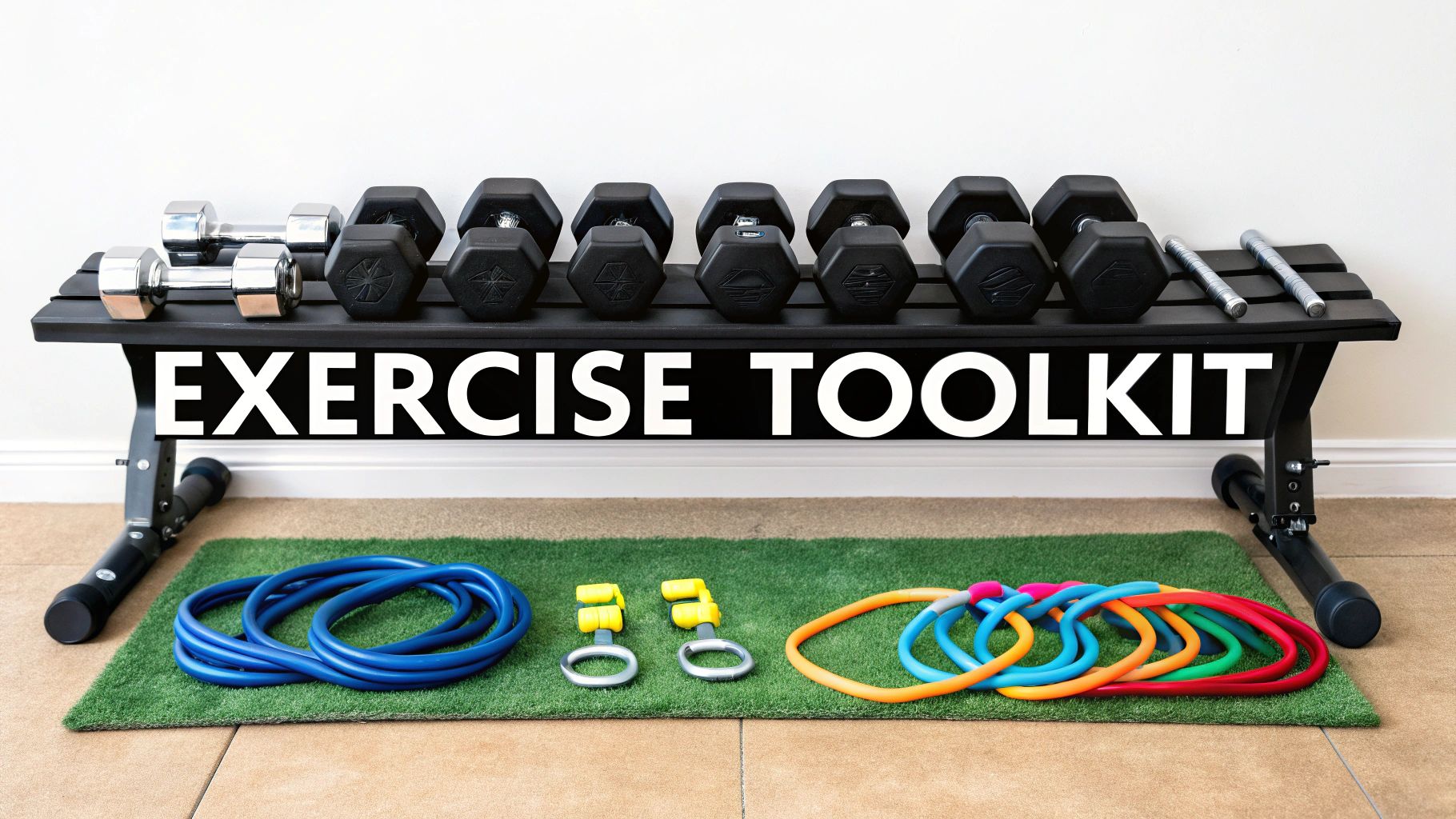
This is where the real work begins. Forget those endless lists of fifty different glute exercises you see online. To actually grow your glutes, you need a focused toolkit—a handful of powerful, proven movements that hit every single muscle fiber, from every angle.
We’ll break it down into three simple categories. First up are the Foundational Builders—the heavy hitters for building size and strength. Then we have the Isolation Sculptors, which let you target specific areas to create shape and definition. Finally, we’ll cover the Essential Stabilizers, the unsung heroes that prevent injury and create that full, rounded look.
The Foundational Builders
These are your non-negotiables for adding serious mass. They’re the big, compound lifts that let you move a ton of weight—and moving heavy weight is what triggers real muscle growth (hypertrophy). Think of these as the concrete foundation of your glute-building plan.
Barbell Hip Thrust: If there's one king of glute exercises, this is it. The hip thrust forces your glutes to work their hardest at the very top of the movement, which is exactly what you need for growth. It also takes your quads out of the equation so you can focus everything on your glutes.
- Pro Tip: Don't just lift the weight. Pause for a solid second at the top of every single rep and squeeze your glutes as hard as you can. That mind-muscle connection is what separates good results from great ones.
Romanian Deadlift (RDL): This move is a powerhouse for your entire posterior chain, especially the part where your glutes and hamstrings tie together. The RDL teaches you to hinge at your hips, putting the glutes under a deep stretch with weight, which is a massive stimulus for building muscle.
The Isolation Sculptors
While the big lifts build the foundation, isolation work is how you add the finishing touches. These exercises let you zero in on specific parts of your glutes—like the often-ignored gluteus medius and minimus—to create that "shelf" look and a rounder shape.
They're also perfect for adding more training volume without the full-body fatigue that comes with heavy compound lifts.
Cable Kickbacks: A gym staple for a reason. The cable keeps constant tension on your glute through the entire movement, something you just can't get with free weights. The key here is control—no swinging your leg with momentum.
- Pro Tip: Instead of just kicking back, think about pushing your heel toward the wall behind you. This small mental cue helps you engage your glute max much more effectively.
Hip Abduction Machine: This machine directly hits the muscles on the sides of your hips (your gluteus medius and minimus). Building these up is the secret to getting a fuller, rounder shape from all angles and improving hip stability for stronger squats and deadlifts.
Remember, consistency is just as important as variety. Pick a couple of exercises from each category and stick with them for at least 4-6 weeks. This gives you enough time to master the form and actually see progress before you think about swapping anything out.
The Essential Stabilizers
These might not feel as glamorous as a heavy hip thrust, but they are absolutely critical. These movements build functional strength, prevent injuries, and help create a balanced, athletic look. They often force you to work one leg at a time, making all those smaller stabilizing muscles in your glutes fire up.
And don't underestimate them. Research has shown that exercises like step-ups can produce some of the highest glute activation levels, often hitting over 100% of maximum voluntary isometric contraction (MVIC). That’s more than you’ll see in many other popular lifts, making them a seriously potent tool.
Here are two of the best:
Bulgarian Split Squats: This single-leg exercise is humbling but incredibly effective. It hammers your balance and stability while putting a massive stretch on the glute of your front leg. It's also one of the best ways to fix strength imbalances between your left and right sides.
Single-Leg RDLs: This variation takes the classic RDL and adds a major balance challenge. Your glute medius has to work overtime just to keep your hips from dropping. Start with just your bodyweight to nail the form before you even think about adding dumbbells.
Here’s a quick breakdown of how it all fits together:
| Exercise Type | Primary Goal | Example Exercises |
|---|---|---|
| Foundational Builders | Build overall mass & strength | Barbell Hip Thrust, RDLs, Squats |
| Isolation Sculptors | Target specific muscles for shape | Cable Kickbacks, Hip Abductions |
| Essential Stabilizers | Improve balance & functional strength | Bulgarian Split Squats, Step-Ups |
Putting this all into a structured routine can feel overwhelming, especially if you're just getting started. If you want a clear roadmap, check out our guide on the perfect beginner gym workout plan. It puts these principles into an easy-to-follow program to get you started on the right foot.
Mastering Progressive Overload for Glute Growth
Ever feel like you’re spinning your wheels at the gym? You’re putting in the work, you’re consistent, but your glutes just aren’t growing. The problem probably isn’t your effort—it’s that you’re missing the single most important rule of building muscle: progressive overload.
Think of it this way: your glutes are smart. They adapt. If you do the same workout with the same weight for the same reps every week, they’ll eventually go, "Okay, I can handle this," and stop growing. Progressive overload is just a fancy term for making sure your muscles never get too comfortable. You have to consistently give them a reason to get stronger and bigger.
It's Not Just About Lifting Heavier
Most people hear "progressive overload" and immediately think they need to pile more plates on the bar. While adding weight is a fantastic way to progress, it’s not the only way. In fact, if you only focus on weight, you’ll eventually hit a wall where your form breaks down.
There are smarter ways to keep challenging your glutes and forcing them to grow.
- Do More Reps: Last week you did hip thrusts with 135 lbs for 8 reps. This week, your goal is to hit 9 or 10 reps with that same weight. Once you can nail 12 reps without your form falling apart, you’ve earned the right to go heavier.
- Add Another Set: Already doing 3 sets of Bulgarian split squats? Awesome. Next week, do 4. That extra set adds up to a lot more total work, which is a huge trigger for growth.
- Perfect Your Form: This is one of the most underrated ways to progress. Instead of just moving the weight, control it. Slow down the lowering phase of a lift (the eccentric) or pause for a second at the top of a hip thrust when your glutes are squeezed tight. This dramatically increases the time your muscles are working.
- Cut Your Rest Time: If you usually rest for 90 seconds between sets, try cutting it to 75 or even 60 seconds. This makes your workout more intense and forces your muscles to recover faster, creating a whole new kind of challenge.
Don't try to do all of these at once. Pick one thing to improve on for each exercise, each week. That’s how you turn random gym sessions into a real plan.
If You Don’t Track It, It Doesn’t Count
Showing up to the gym without a plan is a surefire way to get zero results. You can’t progress if you don’t remember what you did last time.
This is why a workout journal is non-negotiable. It can be a dusty old notebook or a simple app on your phone—it doesn’t matter. What matters is that you write things down.
For every workout, log these four things:
- Exercise
- Weight
- Reps
- Sets
It’s also helpful to add a quick note on how it felt. Was it easy? Did that last rep feel impossible? This habit takes two minutes but gives you a clear target to beat every single time you walk into the gym. No more guesswork.
This infographic breaks down what that progression actually looks like when you put it all together.
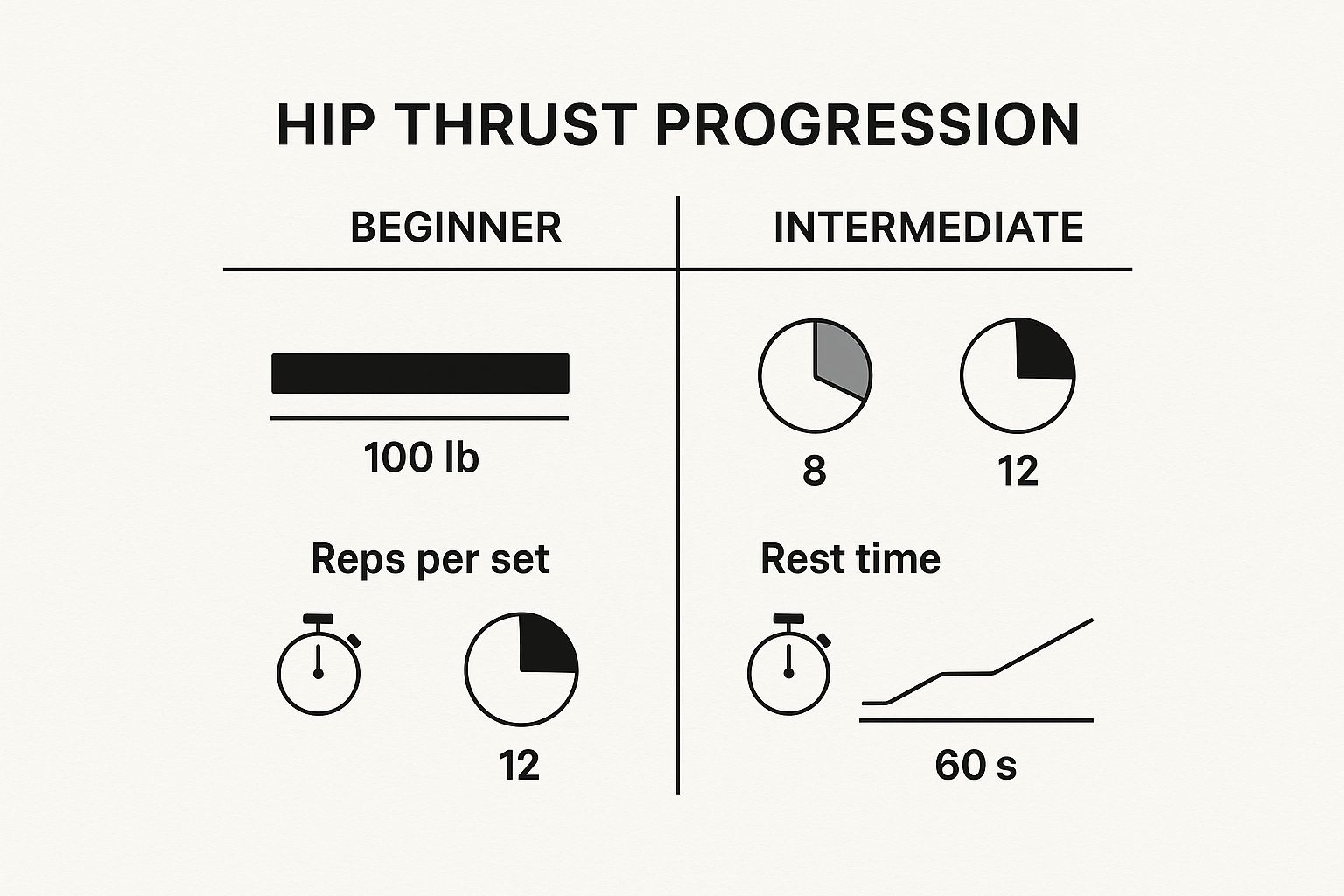
As you can see, an intermediate isn’t just lifting double the weight. They’re also doing more reps with less rest. That’s how you get real, noticeable growth—by challenging your body from every angle over time.
Squats vs Hip Thrusts: The Real Difference
It’s the big debate in glute training: if you could only pick one, which would it be? For years, everyone called the squat the undisputed king of lower-body day. But in the world of building a better booty, the barbell hip thrust has come for the crown.
The truth? This isn't a fight with one clear winner. Squats and hip thrusts are different tools for slightly different jobs. Figuring out their unique strengths is how you program them intelligently for maximum glute growth.
The Biomechanics Breakdown
The real difference comes down to the direction of resistance and where your glutes have to work the hardest.
With a squat, you’re fighting gravity straight down. The toughest part of the lift is at the bottom, when your glutes are in a deep stretch. This is fantastic for building raw strength and overall lower-body mass.
A hip thrust, on the other hand, creates horizontal resistance. Your glutes are under the most tension at the very top of the movement—that moment of full hip extension where you’re squeezing as hard as you can. That point of peak contraction is something a squat just can’t replicate.
This mechanical difference has a huge impact on which muscles get the most work.
Muscle Emphasis: Where Each Exercise Hits
Squats are a true compound movement. They absolutely hit your gluteus maximus, but they also bring your quads (thigh muscles) and adductors (inner thighs) heavily into the mix. For a lot of women, this means their legs might grow faster than their glutes, which isn't always the goal.
Hip thrusts are far more targeted. By taking the deep knee bend out of the equation, they isolate the glutes—especially the gluteus maximus—to a much higher degree. If your main goal is growing your glutes with minimal impact on your leg size, the hip thrust is the more direct tool for the job.
A common mistake is thinking one is a replacement for the other. A better approach is to see the squat as your foundational strength builder and the hip thrust as your primary glute-shaping tool.
This isn’t just gym-bro wisdom anymore; the science is starting to back it up. A recent randomized controlled trial found that while both lifts led to serious glute growth, they shine in different areas. The hip thrust group saw a slight edge in direct glute muscle growth, while the squat group packed on more size in their quads and adductors. You can check out the full analysis of squats vs hip thrusts for glute growth to see the detailed findings.
Squats vs Hip Thrusts: A Head-to-Head Comparison
Sometimes seeing it all laid out makes the choice clearer. This table breaks down what each exercise brings to the table, helping you decide where they fit into your plan.
| Feature | Barbell Squat | Barbell Hip Thrust |
|---|---|---|
| Primary Glute Action | Glute engagement is highest at the bottom of the movement (stretched position). | Glute engagement is highest at the top of the movement (contracted position). |
| Main Muscle Focus | Glutes, Quadriceps, Adductors, and Core. | Gluteus Maximus is the primary mover, with some hamstring and core involvement. |
| Hypertrophy Outcome | Excellent for overall lower body development, including significant leg growth. | Superior for isolating the glutes to build size with minimal quad development. |
| Best Used For | Building foundational strength, improving athleticism, and overall leg mass. | Maximizing glute hypertrophy, creating a "shelf" look, and improving hip extension power. |
So, what’s the takeaway for your workout program? It's simple: you don't choose. You use both.
A great strategy is to start your workouts with a heavy compound lift like the squat to build that raw, foundational strength. Then, follow it up with heavy hip thrusts to directly target and exhaust the glutes, driving growth exactly where you want it most.
Fueling Growth with Smart Nutrition and Recovery
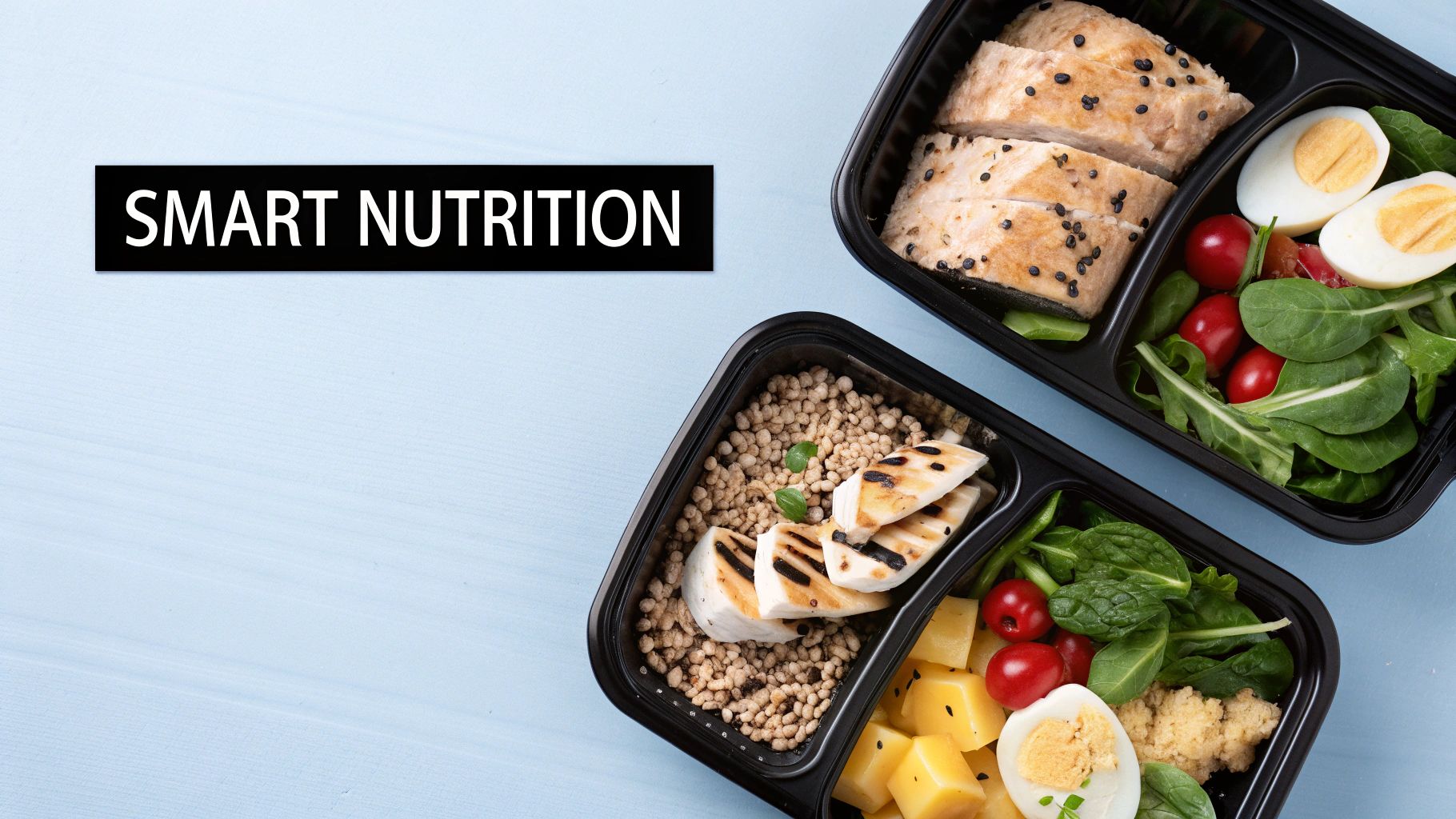
Here's a hard truth: all the hip thrusts and RDLs in the world won't build an ounce of muscle if you aren’t feeding your body right. Your workouts are just the signal. The real growth happens when you give your muscles the fuel and rest they need to rebuild.
This is where so many people get it wrong. They crush it in the gym but completely ignore their nutrition and recovery, then wonder why their glutes aren't growing. Let's cut through the noise and make this simple.
Calorie Surplus: Your Green Light for Growth
You can't build something from nothing. To create new muscle tissue—what the pros call hypertrophy—your body needs extra energy. That means you have to be in a slight calorie surplus, eating a little more than you burn each day.
Don't let that scare you. This isn’t an excuse to eat everything in sight. A small, controlled surplus of 200-300 calories over your daily maintenance is the sweet spot. It gives your body just enough fuel to build muscle without piling on unwanted fat.
Protein: The Absolute Building Blocks
If calories are the energy for the construction site, protein is the actual brick and mortar. Lifting weights creates tiny micro-tears in your muscles. Protein is what your body uses to patch them up, making them bigger and stronger than before.
For women serious about glute growth, aim for 0.8 to 1.0 gram of protein per pound of body weight. So, if you weigh 140 pounds, you're shooting for 112-140 grams every single day.
Your muscles can only grow when you're in a positive protein balance—meaning you're eating more protein than your body is breaking down. Hitting your daily target is non-negotiable.
Try to spread your protein out over 3-4 meals to help your body absorb it better. Stick to high-quality sources like these:
- Lean Meats: Chicken breast, turkey, lean ground beef.
- Fish: Salmon, tuna, and tilapia.
- Eggs & Dairy: Greek yogurt, cottage cheese, and whole eggs are fantastic.
- Plant-Based Options: Lentils, chickpeas, tofu, and quinoa.
Carbs Are Not the Enemy
Carbs have gotten a bad rap, but they are absolutely essential for building muscle. Think of them as your body's primary energy source. They refill the glycogen stores in your muscles that you burn through during tough workouts.
Eating carbs around your training window—before and after—gives you the power to lift heavy and kickstarts the recovery process. Focus on complex carbs like oats, sweet potatoes, and brown rice for sustained energy that won't leave you crashing.
The Non-Negotiables: Hydration and Sleep
You can have the perfect diet and the most killer workout plan, but if you’re dehydrated or sleep-deprived, you're shooting yourself in the foot. Water is critical for moving nutrients where they need to go and keeping your muscles working properly. Aim for at least half your body weight in ounces of water per day.
But sleep? That’s where the real magic happens. During deep sleep, your body releases human growth hormone (HGH), which is vital for muscle repair. Skimping on sleep will crush your recovery, tank your performance, and mess with your hunger hormones. Make 7-9 hours of quality sleep a priority.
And if you’re looking for an extra edge, certain supplements can help. Creatine, for example, is a game-changer for strength and recovery. To see how it can fit into your routine, check out our guide on the best creatine for glute growth.
Your Top Glute Growth Questions Answered
When you’re starting to build your glutes, it’s easy to get overwhelmed. The internet is full of conflicting advice, and you’re bound to have questions.
Let's cut through the noise. Here are the real, no-fluff answers to the biggest questions about timelines, genetics, and training frequency so you can stay focused and confident.
How Long Does It Realistically Take to See Glute Growth?
This is the big one. The honest answer? It depends, but patience is non-negotiable.
You’ll probably feel stronger and more connected to your glutes within 2-4 weeks. But visible, measurable changes in muscle size? That takes a bit longer.
For most women putting in consistent work—both in the gym and in the kitchen—noticeable growth usually starts showing up around 3-6 months. Serious, head-turning results? That’s a commitment of a year or more. Don't let social media’s instant transformations fool you. Real, sustainable muscle is built slow and steady.
Key Takeaway: Stop staring in the mirror and start tracking your lifts. Focus on adding weight to the bar or getting one more rep. When you’re consistently getting stronger, the aesthetic changes will follow.
How Much Do Genetics Affect Glute Growth?
Let's be real: genetics play a big role. Your natural body shape, where you store fat, and even how your muscles attach to your bones all influence how your glutes look.
Some people just build muscle more easily in their lower body. Others have to fight for every inch. But genetics are not an excuse. Smart training and consistent nutrition can absolutely overcome a less-than-ideal starting point. Your glutes might not end up looking exactly like that influencer on your feed, but you can build a stronger, fuller, more sculpted version of your own.
How Often Should I Train Glutes?
The sweet spot for most women is training glutes 2-3 times per week.
This hits the perfect balance. It’s enough stimulus to signal growth, but it also gives your muscles the crucial 48-72 hours they need to recover, repair, and come back stronger. Any more than that, and you risk overtraining. Any less, and you’re leaving gains on the table.
A smart split is having one heavy, compound-focused day (think hip thrusts and RDLs) and one lighter, higher-rep day focused on isolation and pump work.
Can I Grow My Glutes Without Growing My Legs?
Yes, you absolutely can. It all comes down to exercise selection. While squats and lunges are great overall, they hammer your quads. If you want to build the booty while keeping your legs from getting bigger, you need to make hip-dominant exercises the star of the show.
Build your workouts around these movements to keep the tension on your glutes:
- Barbell Hip Thrusts: The undisputed king of glute isolation.
- Cable Kickbacks: Perfect for targeting the gluteus maximus.
- Hip Abductions: The secret to building that gluteus medius "shelf."
- Romanian Deadlifts (RDLs): The best for hitting that glute-hamstring tie-in.
You have the plan and the answers. Now it’s time to start building. If you’re looking for an extra edge to support your recovery and strength, Bold Buns offers clean, effective supplements designed for women. Our creatine formula is made to help you push harder, recover faster, and sculpt the strong, confident body you deserve.