

The Ultimate Guide to Pill Form Creatine for Women
Tired of scooping powders and dealing with messy spills? If you're curious about creatine but turned off by the giant tubs, pill form creatine is the simple, no-fuss answer you've been looking for.
Think of it this way: creatine powder is like buying all your groceries in bulk. Creatine pills are like a perfectly portioned meal kit—all the benefits, none of the guesswork. It’s the go-to for women who want results without the hassle.
The Simple Power of Pill Form Creatine
Let's be real—for many women, the thought of shaking up another gritty drink is a huge turn-off. That’s exactly where pill form creatine comes in. You get the same powerful, energy-boosting compound that’s in the powder, but it’s packed into a simple, easy-to-swallow capsule.
This format just makes sense. No more shaker bottles rolling around in your car, no more powder dusting your kitchen counter, and no more choking down a chalky drink. Just grab what you need and you're good to go.
Why Convenience Matters
For anyone juggling a packed schedule, simplicity is everything. Creatine pills are the ultimate grab-and-go solution that fits right into your gym bag, purse, or suitcase. That convenience makes it so much easier to stay consistent, and consistency is what actually gets you results.
For women who need their routine to be as straightforward as possible, creatine pills are the cleanest path to boosting performance without adding another complicated step to your day.
A Growing Market Trend
And it's not just us saying it—the demand for easier supplements is a huge market trend. The global creatine supplement market is exploding, projected to grow from USD 0.7 billion to an estimated USD 4.7 billion by 2034.
This massive jump shows that people are tired of complicated products and are actively seeking out user-friendly options like pill form creatine. You can dig into the numbers yourself in detailed industry reports.
This guide will be your roadmap. We’ll break down how creatine actually works to fuel your muscles, tackle common worries like bloating, and give you the confidence you need to make it work for you.
How Creatine Actually Fuels Your Workouts
Before we get into why creatine pills are so convenient, let’s quickly cover what creatine actually does in your body. It’s not some weird, synthetic chemical—your body already makes it. Taking a supplement is just like topping off your fuel tank so you can perform your best.
Think of your muscle cells as tiny, rechargeable batteries. The energy they run on is called adenosine triphosphate (ATP). Every single time you lift, sprint, or jump, you burn through ATP, and those batteries drain—fast.
The Rapid Recharge System
This is where creatine comes in. It’s your body’s rapid recharge system for those little cellular batteries. When you supplement, you build up your stores of something called phosphocreatine, which is basically a high-energy molecule ready to go.
When your muscle uses ATP, it becomes a "drained" battery called ADP (adenosine diphosphate). Phosphocreatine is the hero that swoops in, donates its phosphate back to ADP, and instantly turns it back into a fully charged ATP battery.
This super-fast recycling process is the secret to creatine's power. It’s what lets you push out that extra rep or finish a set feeling strong instead of gassed.
If you want to go deeper into the science, check out our full guide on what creatine does inside your body.
And this isn't just theory. Creatine monohydrate is one of the most heavily researched supplements on the planet. With over 25 years of studies, we know it’s safe and incredibly effective at recycling ATP in both muscle and brain tissue. That’s why it’s a game-changer for short, intense efforts like lifting weights.
Optimizing Your Natural Energy
At the end of the day, taking creatine isn't about adding something unnatural. It's about making the energy system your body already has work better. By keeping your phosphocreatine stores full, you give your muscles the immediate fuel they need to work harder and recover faster between sets. This cellular energy boost is what leads to real strength and performance gains in the gym. If you're curious about how other nutrients support your body's energy factories, you can explore other supplements for cellular health.
Creatine Pills Versus Powder: What's Best for You?
So, you're deciding between pill form creatine and the classic powder. Let's get one thing straight: both give you the exact same powerhouse ingredient—creatine monhydrate—that fuels your muscles. The only real difference is how you get it into your system. Think of it like choosing between a vitamin C tablet or a fizzy drink packet. The end result is the same.
The real question is, which one actually fits into your life? Let’s break down the practical pros and cons so you can pick the option that supports your goals without adding another chore to your day.
The Convenience Factor
For most of us, if it’s not easy, it’s not happening. This is where creatine pills are a total game-changer. They are the definition of grab-and-go. You can toss a bottle in your gym bag, keep it in your car, or throw it in your purse and take it with a quick sip of water. No mess, no fuss.
You don't need a shaker bottle, there's no risk of powder explosions on your kitchen counter, and you definitely don't have to chug a gritty drink. If your schedule is already maxed out, pills make staying on track almost effortless.
Pill form creatine takes all the prep work out of the equation, making it so much easier to be consistent. And when a supplement is simple to take, you’re far more likely to do it every single day—which is the only way you’ll see real results.
Powder, on the other hand, just requires more work. You have to find a scoop, measure it out, mix it into a drink, and then shake it like you mean it. It's not a huge deal, but that one extra step can feel like a mountain on days when you’re already running on fumes.
Dosage, Cost, and Digestion
Beyond the convenience, a few other things might sway you one way or the other.
- Dosage Accuracy: Pills are perfectly precise. Each capsule is pre-measured, so you know exactly what you’re getting every time. Powder requires a bit of scooping and leveling, which can mean your dose isn't always 100% consistent.
- Cost-Effectiveness: Let’s be real—powder is almost always cheaper. It costs less to produce and package, so the price per serving is way lower than capsules. If you're on a budget, powder gives you the most bang for your buck.
- Absorption and Digestion: Your body can absorb powder a tiny bit faster since it doesn’t have to break down a capsule first. But honestly, this difference is so small it won't affect your long-term results. Some women actually find that taking a few pills is gentler on their stomach than a full scoop of powder, which can sometimes cause a little bloating if not mixed well.
This diagram breaks down how creatine actually works to fuel your muscles when you're pushing hard in a workout.
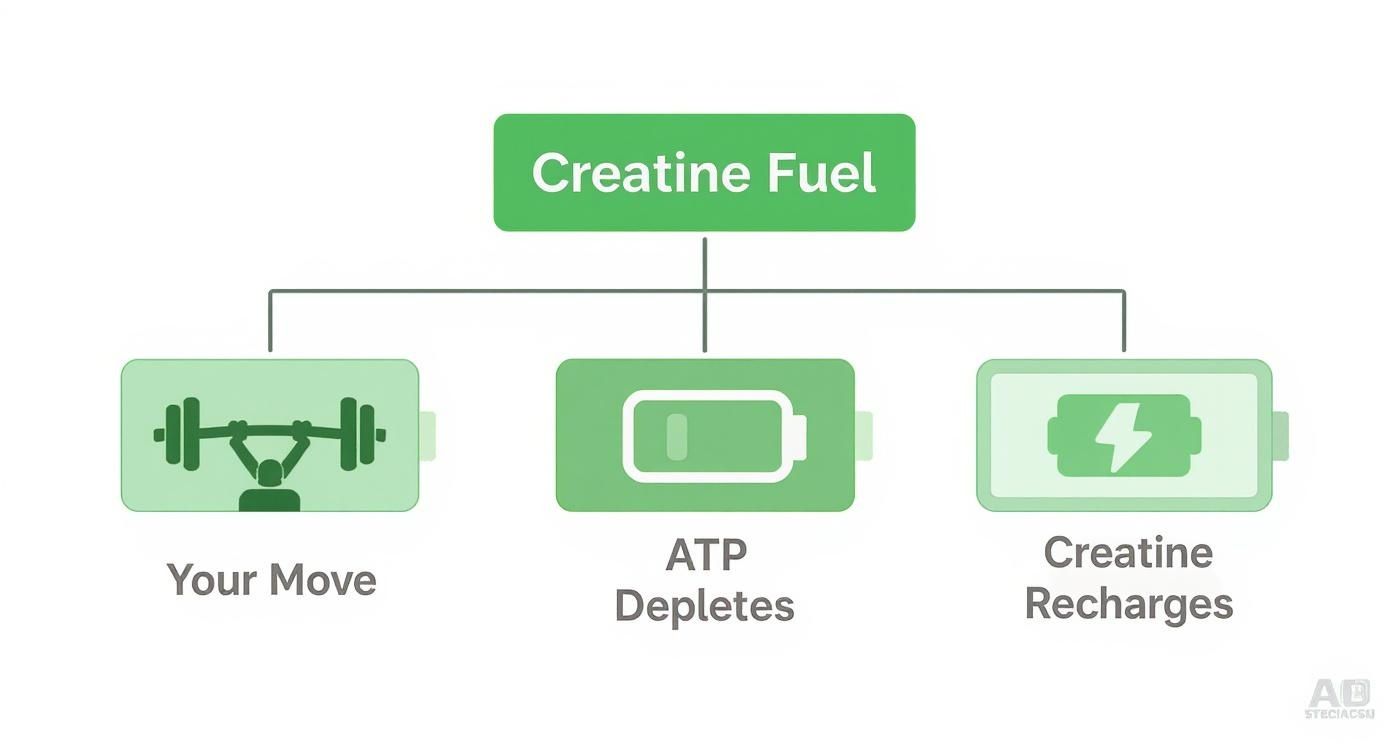
Essentially, creatine acts like a rapid recharger for your cellular batteries (ATP) after you've used them up during intense exercise.
Creatine Pills vs. Powder: A Head-to-Head Comparison for Women
To make the choice even clearer, here’s a straightforward breakdown of how pills and powder stack up against each other based on what matters most for a busy lifestyle.
| Feature | Pill Form Creatine | Creatine Powder |
|---|---|---|
| Convenience | Excellent; perfect for travel and busy schedules. | Fair; requires mixing and a shaker bottle. |
| Dosage Accuracy | High; each pill is a precise, pre-measured dose. | Good; requires careful scooping for accuracy. |
| Cost | Higher cost per serving due to manufacturing. | Lower cost per serving; more economical. |
| Portability | Excellent; easy to carry in any bag. | Poor; tubs are bulky and prone to spills. |
| Stomach Upset | May be gentler for some users. | Can cause discomfort if not mixed well. |
Ultimately, the "best" form of creatine is the one you’ll actually take consistently. If convenience is your top priority and worth the extra cost, pills are a fantastic choice. If you’re budget-conscious and don’t mind a little mixing, powder is a proven and effective option.
Finding Your Ideal Creatine Dosage and Timing
Alright, you’ve picked your creatine. Now for the easy part—actually using it. Nailing your dose and timing with creatine pills is incredibly simple. No guesswork, no mess, just results.
You’ve probably heard of a “loading phase”—that first week of taking huge doses (20 grams or more a day) to flood your muscles with creatine. While it works, it’s also the number one reason women complain about bloating and stomach issues.
Here’s the good news: you can skip it completely. For most women, the smarter approach is to start directly with a simple, steady maintenance dose. This way is much gentler on your system and gets you the exact same results over time, without any of the uncomfortable side effects.
Your Simple Daily Dose
To build strength and get more out of your workouts, the science points to one number: 3 to 5 grams of creatine per day. That’s the sweet spot to keep your muscles topped off without going overboard.
With creatine in pill form, you just need a quick look at the label to figure out your daily number.
- If one capsule has 1 gram (1000 mg): You’ll take 3 to 5 pills a day.
- If one capsule has 750 mg: You’ll need 4 to 7 pills to hit that target range.
The pre-measured capsules mean you get a perfect dose every single time. No scoops, no scales, no problem.
The only rule that truly matters with creatine is consistency. Taking it every day keeps your muscles saturated, which is the key to seeing real results. Think of it like watering a plant—a little bit every day does way more good than a huge amount once in a while.
When to Take Your Creatine Pills
While taking it daily is non-negotiable, you can give yourself a slight edge with timing. Some research shows that taking your creatine pills after your workout with a meal that has carbs and protein can help a little. The insulin spike from the food can help push the creatine into your muscles a bit more efficiently.
But don’t stress about it. The difference is tiny. The best time to take your pills is whatever time you know you won’t forget—with breakfast, before the gym, or right after you train. Consistency will always beat perfect timing.
If you want to get really granular, check out our guide on the best time to take creatine for muscle growth. Otherwise, just pick a time and stick to it. That's how you'll win.
Addressing Common Safety Concerns for Women
When it comes to supplements, it’s smart to ask questions. Creatine, especially for women, often brings up a ton of concerns—everything from bloating to whether it’s safe to take at different stages of life. Let’s clear the air with some straight talk and science, so you can feel good about adding pill form creatine to your routine.
The biggest myth we need to bust right now is the one about water weight. A lot of women worry creatine will make them look puffy or bloated, but that’s a misunderstanding of how it actually works. Creatine does pull water into your body, but it pulls it inside your muscle cells, not under your skin.
This process is called cellular hydration, and it’s actually a huge plus. It’s what gives your muscles that fuller, more toned look—not a bloated one. That dreaded puffy feeling is usually tied to the high-dose loading phases people do with powder, a step you can totally skip with a steady, daily dose of creatine pills.
Creatine Use During Postpartum Recovery
For new moms looking to get their strength back after pregnancy, creatine can be a fantastic tool. The whole postpartum journey is about regaining muscle and energy, and that's exactly where creatine shines. But, this stage of life requires a little extra caution.
Research on taking creatine while breastfeeding is still pretty limited. That’s why it's absolutely essential to chat with your doctor or a registered dietitian before starting. They can give you personalized advice that fits your health history and help you make the safest choice for you and your baby.
Creatine is one of the most studied sports supplements on the planet. Decades of research have confirmed it’s safe for long-term use in healthy people. When used right, it is not a steroid and it won’t harm your kidneys or liver if you don’t have pre-existing conditions.
Ensuring Purity and Quality
The supplement world can feel like the Wild West, which makes product quality a real safety concern. To make sure the pill form creatine you pick is pure and doesn't have any nasty contaminants, always look for products that have been third-party tested. Seeing a certification from a group like NSF or Informed-Sport means it’s been independently checked out and verified.
When you're thinking about safety and choosing the right creatine, knowing how to spot quality is key. For more on this, check out this helpful guide to finding third-party tested supplements.
Bottom line? When you use it responsibly, creatine is a safe and seriously effective way for women to get more out of their hard work. For a deeper dive into this, you can also check out our detailed breakdown on whether women can take creatine.
How to Choose the Right Creatine Pills
Walking through the supplement aisle feels like a pop quiz you didn't study for. But picking the right pill form creatine is actually pretty simple once you know the rules of the game.
First thing's first: ignore the flashy marketing and turn the bottle around to the ingredients list.
You're looking for one thing: creatine monohydrate. Don't get distracted by fancy, expensive variations. Monohydrate is the most researched, trusted, and proven form on the planet. For decades, it's been the undisputed gold standard for a reason—it works.
Look for Third Party Certifications
Here’s the thing about the supplement industry—it’s not tightly regulated. That means you can’t always trust what the label says. This is where third-party certifications become your non-negotiable.
Think of these certifications as an unbiased fact-checker. They send the product to a lab to confirm what's on the label is actually what's in the pill, and that it's free of any gross contaminants or banned substances.
Keep an eye out for these logos:
- NSF Certified for Sport: This is a big one. It means the product has exactly what it claims, without any unsafe extras.
- Informed-Sport: They test every single batch for prohibited substances before it ever hits the shelf.
Choosing a certified product isn't just about getting your money's worth; it's about safety and peace of mind.
When you're investing in your health, you deserve to know exactly what you're putting in your body. Third-party testing takes all the guesswork out of it and ensures you’re getting a quality supplement.
Check the Practical Details
Last but not least, check the nitty-gritty details on the supplement facts panel. How much creatine is actually in each pill? It could be 750mg, or it might be 1000mg (which is 1 gram). This number tells you how many capsules you’ll need to swallow to hit your daily 3-5 gram goal.
Also, take a peek at the capsule material. Most are made from gelatin (which comes from animal sources). If you're vegetarian or vegan, you’ll want to look for veggie caps, usually made from hypromellose. A quick check here ensures the supplement fits both your fitness goals and your lifestyle.
Common Questions About Creatine Pills for Women
Even with all the facts, a few questions always come up when you’re thinking about starting creatine pills. Let's clear up those last few details so you can get started with total confidence.
Will Creatine Pills Make Me Look Bulky?
This is the number one myth we need to bust, so let’s be direct: No.
Creatine helps you build lean, strong muscle—not bulky mass. It works by pulling water into your muscle cells, giving them a fuller, more toned look. This isn't the same as the puffy, under-the-skin bloating you might be worried about.
Real bulk comes from a very specific style of training combined with eating a massive calorie surplus. A simple 3-5 gram dose of creatine isn’t going to do that.
How Long Until I See Results?
Patience and consistency are everything. If you skip the loading phase and just stick to a daily maintenance dose of 3-5 grams, you can expect to feel and see a difference in your strength in about 3 to 4 weeks.
That’s how long it takes for your muscles to become fully saturated with creatine. Once they are, you'll be able to push harder during your workouts.
Your first sign of success won’t be in the mirror, but in your performance—that extra rep you couldn't hit last week or feeling stronger on your last set.
Do I Need to Stop Taking It?
Nope, there's no need to cycle creatine. It’s not a steroid or a stimulant that your body needs a break from.
Decades of research show that consistent, long-term use is safe and effective. Once you start, you can keep taking it daily to maintain those performance benefits for as long as it aligns with your fitness goals.
Ready to build strength with unmatched convenience? Bold Buns offers a premium, clean creatine formula designed for women who are serious about their results. Get the power of creatine in a simple, no-fuss pill.