
The muscle loss nobody warns you about starts in your 30s
By the time perimenopause shows up, most women have already been quietly losing muscle for a decade. Here's what's actually happening, and the five things research shows can help.

Most women picture muscle loss as something for their 70s. Not their 30s. But it starts in your 30s, quietly, with no symptom and no warning, years before perimenopause is anywhere on your radar. After 30, the average person loses 3 to 8% of their muscle mass every decade. Nobody tells you. There's no test, no appointment, no moment where a doctor sits you down and says start now. You just wake up one day noticeably weaker than you used to be, carrying groceries in two trips instead of one, needing a hand to get up off the floor, and by then, years of it are already gone. Then perimenopause hits, estrogen drops, and that quiet decline can speed up to roughly twice the rate it was running at before.
This is one of the most preventable parts of aging, and one of the best-researched tools for slowing it down is one you've probably already heard of.
1It fights the muscle loss that starts before you'd ever expect it
Sarcopenia, the medical term for age-related muscle loss, doesn't wait for menopause. It typically begins around age 30, chipping away 3 to 8% of muscle mass per decade from a baseline you probably never think about protecting. Creatine works by helping muscle cells regenerate ATP faster, the energy your muscles burn during resistance training. Combined with strength training, research consistently shows creatine supports greater gains in muscle strength and lean mass than training alone, which is exactly the combination that slows this decline down.

2It offsets the acceleration that hits during perimenopause
Here's the part that catches most women off guard: once estrogen starts declining in perimenopause, the muscle loss that was already happening speeds up, research shows postmenopausal women lose muscle at roughly twice the rate of premenopausal women at the same activity level, since estrogen has a protective effect on muscle tissue that fades as it drops. A 14-week clinical study in peri- and postmenopausal women confirmed that creatine paired with strength training produced significant increases in lower-body strength, precisely the window where that support matters most.

3It supports bone strength during the stage bone loss speeds up most
Estrogen doesn't just protect muscle, it protects bone too, and up to 20% of bone loss happens during the menopause transition, at the exact stage women are already losing muscle fastest. A year-long clinical study of postmenopausal women doing resistance training confirmed the impact: the group taking creatine lost just 1.2% of bone density at the femoral neck, a common fracture site, compared to nearly 4% in the placebo group. More than three times the bone loss, from skipping one supplement.

"I started taking it more for energy, but my doctor actually commented on my strength numbers at my last physical. Wish I'd started in my 30s instead of my 40s." Denise R., verified customer
4It fights the brain fog that shows up in your 40s and 50s
Forgetting a word mid-sentence, walking into a room and blanking on why, these are some of the most commonly reported symptoms of perimenopause, and there's a real mechanism behind it. Estrogen fuels the hippocampus, your brain's memory center, and as levels fluctuate, that fuel supply gets less reliable. Creatine is stored in the brain as well as muscle, and clinical studies in adults aged 45 to 64 confirm it improves short-term memory and cognitive performance, especially under stress or sleep deprivation, exactly the combination many women are running on during this stage.

5It supports mood and sleep during a stage that disrupts both
Mood swings and disrupted sleep are two of the most exhausting parts of perimenopause, and the research backs creatine up on both. That same 14-week clinical study found meaningful improvements in sleep quality among perimenopausal participants. Separately, research combining creatine with standard depression treatment produced greater symptom improvement than treatment alone.
Does this replace HRT?
No, and it shouldn't try to. Creatine doesn't address hot flashes, vaginal dryness, or the hormonal root of perimenopause the way HRT can. What it does is support the muscle, strength, and training response that keeps your body resilient through this stage, alongside whatever else you and your doctor decide is right for you.
None of this requires a men's bodybuilding protocol or a loading phase. The research above used a simple daily dose (most studies land around 5g), taken consistently, alongside regular resistance training. That's the same formula we built Bold Buns Creatine Boost around.

"Started this at 47 mostly for my joints and energy. Didn't expect it to also help me sleep better, but here we are." Karen T., verified customer
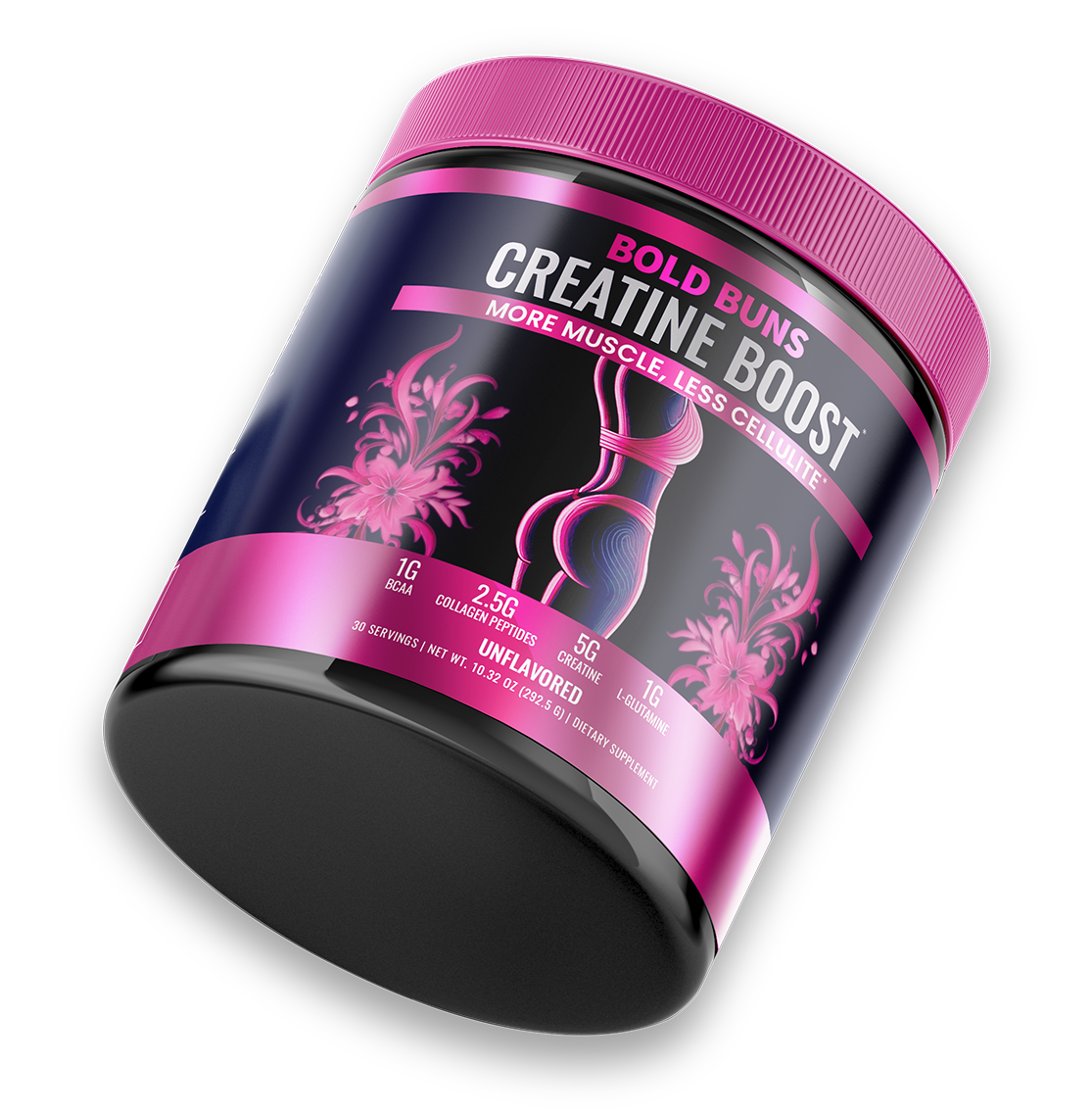
Built for this stage, not a men's protocol
A clean 5g daily dose, no loading, no fillers
Micronized creatine monohydrate, plus Verisol® collagen peptides for skin and BCAAs for recovery. See the research, the ingredient list, and current pricing.
See Bold Buns Creatine Boost →?Quick questions we kept getting
Is creatine safe to take alongside HRT?
There's no known interaction between creatine and hormone replacement therapy. As always, it's worth mentioning any supplement to your doctor, especially since creatine can slightly raise serum creatinine on bloodwork, which is expected and not a sign of kidney harm.
Will this help with hot flashes or vaginal dryness?
No, and we'd rather tell you that upfront than oversell it. Creatine's research base is around muscle, strength, bone-supporting training, brain function, and mood. Vasomotor symptoms are outside what it's shown to help with.
How soon will I notice a difference?
Most studies showing strength and sleep benefits ran 12 to 14 weeks with consistent daily use and twice-weekly resistance training. Some women notice energy differences sooner, but the muscle and bone-supporting benefits build gradually, the same way the muscle loss did.