

How to Get Rid of Hip Dips: A Realistic Guide
Here’s the deal: you can’t just get rid of hip dips. They’re a normal part of your bone structure. But what you can do is build up the muscles around them to create a fuller, rounder shape that makes those indentations way less noticeable.
The most effective game plan? Build muscle in your glutes and the surrounding hip area with targeted exercises. It's all about creating a silhouette that softens the dips.
What Are Hip Dips and Can You Really Get Rid of Them?
If you've ever looked in the mirror and seen slight indentations on your sides, right below your hip bones, you've found your hip dips. They’re sometimes called "violin hips," and they've gotten a bad rap online, often framed as some kind of flaw you need to "fix."
Let's get one thing straight: hip dips are not a sign that you’re unhealthy, out of shape, or carrying too much body fat.
They are a completely normal part of human anatomy. Period.
Their appearance comes down to your unique genetics and skeleton—specifically, the shape of your pelvis. It's the space created by the width of your ilium (the top of your hip bone) and the angle of your femur (thigh bone) that causes the dip. Some people have a bone structure that makes them more obvious, and others don't.
Setting Realistic Expectations
Because hip dips are literally built into your bone structure, no workout or diet on earth can make them vanish completely. It's so important to get this straight before you start. Instead of trying to fight your natural anatomy, a much smarter and healthier goal is to minimize their appearance by building muscle.
By growing the muscles around your hips—especially the gluteus medius and minimus (the upper/side parts of your butt)—you can add volume right where you want it. This new muscle helps "fill in" the area, creating that rounder, more sculpted look you're after.
Think of it less as a war against your body and more as working with your natural shape to build strength and feel amazing. That’s exactly what this guide is designed to help you do.
The Truth About Hip Dips
It’s easy to get tangled up in myths. To set the record straight, having hip dips is incredibly common and natural. A huge 2015 review from the Global Hip Dysplasia Registry noted that these "trochanteric depressions" are found across the global population, with their visibility just depending on a person's genetics and body composition.
Key Takeaway: Hip dips are a result of your unique bone structure, not your fitness level or body fat. The goal isn't to erase a normal part of your anatomy—it's to build strength and muscle to enhance your natural curves.
To help you get into a positive and realistic headspace, let's bust some of the most common myths out there.
Hip Dips The Myths vs The Reality
Here's a quick breakdown to separate the social media fiction from anatomical fact.
| Common Myth | Anatomical Reality |
|---|---|
| "Hip dips are a sign of being overweight." | Hip dips are caused by bone structure. Body fat can sometimes make them less noticeable. |
| "You can spot-reduce fat from your hips." | It's impossible to target fat loss from one specific area of your body through exercise. |
| "The right exercises will eliminate them." | Exercise can build muscle to reduce their appearance but cannot change your skeletal shape. |
| "Only unfit people have hip dips." | Many professional athletes and fitness models have prominent hip dips due to low body fat. |
Now that we've cleared that up, you can stop blaming your body and start working with it.
Building Stronger Glutes to Reduce Hip Dips
Alright, we’ve covered the anatomy behind hip dips. Now let's get to the good part: building the muscle that can actually change your shape. While you can't change your bone structure, you absolutely have the power to grow the muscles that attach to it. This is where the real work—and the results you’re looking for—happen.
The goal is to target the muscles surrounding your hips, especially the glutes. By making these muscles bigger and stronger, you add natural volume that helps "fill in" those indentations, making them way less obvious. Think of it as adding padding from the inside out, but with strong, functional muscle.
Your Glute Anatomy Crash Course
Your glutes aren't just one muscle. They're a team of three, and to really see a change in your shape, you need to work all of them. For hip dips, two are especially important.
-
Gluteus Maximus: This is the big one. It's the largest and most powerful muscle in your body, and it's what gives your butt that lifted, strong look. Its main job is hip extension—think standing up from a squat.
-
Gluteus Medius: Meet the superstar for filling out hip dips. This muscle sits on the side of your hip and is responsible for moving your leg out to the side (abduction). Building this muscle adds width and fullness right where you need it most.
-
Gluteus Minimus: Tucked just under the gluteus medius, this is the smallest of the three. It helps the medius with abduction and stability. Even though it's small, strengthening it adds another layer of volume to help create that rounder shape.
The secret to minimizing hip dips isn't just doing endless squats. It's about a smart, targeted approach that hammers the gluteus medius and minimus—the muscles that build roundness and width right where it counts.
A solid glute routine hits all three muscles. Big exercises like squats and deadlifts are amazing for the gluteus maximus, but they don't always give the medius and minimus the direct work they need to grow. That's why we're focusing on isolation moves that hit those smaller, shape-defining muscles head-on.
For a deeper dive into overall glute development, our guide on how to grow glutes is a great place to start.
Core Exercises for Fuller Hips
Let's break down the key moves that will be the foundation of your routine. The focus here is quality over quantity. I'm talking perfect form and feeling the right muscles burn with every single rep.
1. Standing Side Leg Raises
This one is a classic for a reason—it hits the gluteus medius directly. It looks simple, but when you do it right, it's incredibly effective.
- How to Do It: Stand tall, feet together, and hold onto a wall or chair for a bit of balance. Keep your core tight and your back straight, then slowly lift one leg out to the side as high as you can without tilting your whole body. Make sure your toes point forward, not up at the ceiling.
- Form is Key: The most common mistake is using momentum or leaning away to swing the leg higher. Don't do it. Keep your torso completely still. The movement should come purely from your hip. Pause at the top and squeeze the side of your glute, then slowly bring your leg back down.
- Sets and Reps: Aim for 3 sets of 15-20 reps on each leg.
2. Clamshells
Don't let this small movement fool you. Clamshells are incredible for waking up and strengthening both the gluteus medius and minimus—exactly what you need for that "upper shelf" look.
- How to Do It: Lie on your side with your knees bent at about a 45-degree angle, heels stacked. Rest your head on your bottom arm.
- Form is Key: Keep your feet glued together and your core engaged. Lift your top knee toward the ceiling without letting your hips rock back. The rest of your body should stay still. Squeeze at the top, then slowly lower your knee back down.
- Sets and Reps: Do 3 sets of 20-25 reps per side. Once that feels easy, loop a resistance band around your thighs to make it harder.
Building Strength and Volume
Once you’ve mastered those activation moves, it's time to bring in the exercises that build serious muscle. These movements let you use more weight, which is the key to growth.
3. Glute Bridges
The glute bridge is a powerhouse for the gluteus maximus, but with one simple tweak, it also lights up the medius. It’s also much easier on your lower back than many other exercises.
- How to Do It: Lie on your back with your knees bent and feet flat on the floor, about hip-width apart. Keep your arms by your sides.
- Form is Key: Squeeze your glutes and lift your hips until your body forms a straight line from your shoulders to your knees. To really hit the medius, put a resistance band around your thighs and actively push your knees outward against it the whole time. Pause at the top for a hard squeeze before slowly lowering back down.
- Sets and Reps: Start with 3 sets of 15 reps. As you get stronger, place a dumbbell or weight plate across your hips for more resistance.
4. Donkey Kicks
This move isolates the glutes to help lift and round them out. The trick is to keep it controlled and not let your lower back arch.
- How to Do It: Get on all fours, with your hands under your shoulders and knees under your hips. Keep your back flat and pull your belly button in.
- Form is Key: Keeping your knee bent at 90 degrees, lift one leg straight back and up. Think about pressing the sole of your foot toward the ceiling. Squeeze the glute on that working leg and don't let your lower back sag.
- Sets and Reps: Go for 3 sets of 15-20 reps on each leg.
5. Fire Hydrants
This is another killer move for the gluteus medius and minimus, hitting your hips from a slightly different angle than the side leg raises.
- How to Do It: Start on all fours, just like with donkey kicks. Maintain that flat back and tight core.
- Form is Key: Keeping your knee bent, lift one leg out to the side, away from your body. Go as high as you can without tilting your hips or torso. The movement looks just like its name suggests!
- Sets and Reps: Aim for 3 sets of 15 reps per side. A resistance band makes this one burn so much more.
By working these exercises into your routine consistently, you’ll give your glute muscles the reason they need to grow. Just remember, building muscle takes time and patience. Stick with it, nail your form, and you will build the strength and shape you're working toward.
Your Weekly Glute-Building Workout Plan
Having a list of exercises is one thing, but showing up consistently with a smart plan is how you actually build muscle. A solid weekly routine makes sure you’re hitting the right muscles hard enough to grow, while also giving your body the downtime it needs to recover. That’s the real secret to seeing progress and filling out those hip dips.
The entire plan is built around one core principle: progressive overload. It sounds technical, but it just means you have to keep challenging your muscles. Your body is smart—it won't change unless you give it a reason to. That means gradually lifting heavier, adding another rep, or shortening your rest periods over time.
Beginner Workout Schedule (2-3 Days Per Week)
If you're just starting out, don't jump into a five-day-a-week plan. That's a fast track to burnout. The goal right now is to master your form and build a solid foundation with two or three full-body workouts each week.
Always give yourself at least one rest day between sessions. Think Monday and Thursday, or maybe Monday, Wednesday, and Friday. This gives your glutes the crucial 48-72 hours they need to repair and grow stronger.
Here’s a simple routine to get you started:
- Glute Bridges: 3 sets of 15 reps (really focus on that squeeze at the top)
- Clamshells: 3 sets of 20 reps per side (keep your hips stacked and still)
- Standing Side Leg Raises: 3 sets of 15 reps per side (control the movement; no swinging)
- Bodyweight Squats: 3 sets of 12 reps (get as deep as your mobility allows with good form)
- Donkey Kicks: 3 sets of 15 reps per side (imagine stamping your heel on the ceiling)
Pro Tip: Grab a notebook and jot down your workouts. When doing 15 reps starts feeling too easy, that's your cue. It’s time to add a resistance band, hold a light dumbbell, or push for 20 reps. That, right there, is progressive overload in action.
This flow chart breaks down the foundational movements that will become the core of your glute-building routine.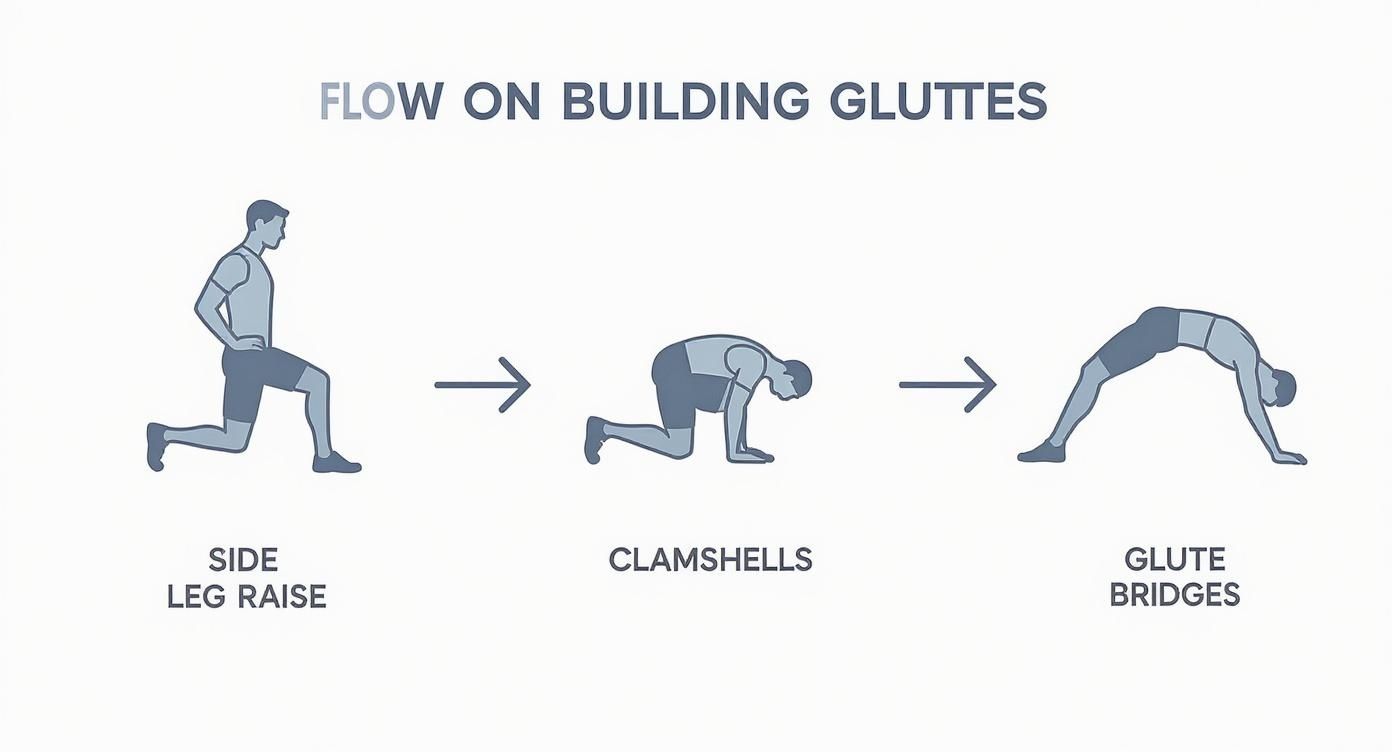
Mastering these three exercises ensures you're hitting the gluteus medius and maximus from all the right angles.
Intermediate Workout Schedule (3-4 Days Per Week)
After a few months of consistent training, you'll feel more confident with the movements. Now, you can crank up the intensity. An intermediate plan often splits workouts by muscle group, which lets you train harder and more often without overdoing it.
A classic "upper/lower" split is perfect for this. You dedicate specific days just to your lower body, giving your glutes the focused attention they need to really pop.
Here’s an example of what an intermediate split could look like, designed specifically to build a fuller lower body and minimize the look of hip dips.
Sample Intermediate Weekly Workout Split
This 4-day split gives your lower body focused attention while still allowing for plenty of recovery time, which is when the real growth happens.
| Day | Focus | Key Exercises |
|---|---|---|
| Day 1 | Glute & Hamstring Focus | Weighted Glute Bridges (4x10), Romanian Deadlifts (3x12), Leg Curls (3x15), Cable Kickbacks (3x15 per leg) |
| Day 2 | Rest or Active Recovery | Light walking, stretching, or yoga. |
| Day 3 | Glute & Quad Focus | Barbell Squats (4x8), Bulgarian Split Squats (3x12 per leg), Leg Press (3x12), Weighted Fire Hydrants (3x15 per side) |
| Day 4 | Rest | Complete rest is essential for muscle repair and growth. |
| Day 5 | Glute Isolation Day | Hip Thrusts (4x10), Banded Side Leg Raises (4x20 per side), Banded Clamshells (4x25 per side), Reverse Hyperextensions (3x15) |
| Day 6 & 7 | Rest or Active Recovery | Allow your body to fully recover for the week ahead. |
This kind of focused training puts more stress on the target muscles—and that stress is exactly what forces them to grow. If you're looking for more structured routines, our detailed booty building workout plan lays out everything you need to take your results to the next level.
Just remember, a smart plan paired with consistency is the ultimate formula for success.
Fuel Your Progress with the Right Nutrition
Think of it this way: your workouts are the construction crew, but your diet is the truckload of bricks and mortar. You can do endless glute bridges and hip thrusts, but if you don't give your body the raw materials it needs, nothing gets built.
This is the non-negotiable part of the process. Without the right fuel, your muscles simply can't repair, rebuild, and grow stronger.
Prioritize Protein to Build and Repair
When you train your glutes, you’re creating tiny micro-tears in the muscle fibers. That’s a good thing! It's the signal for your body to start repairing. Protein provides the amino acids needed to patch up these tears, making the muscle bigger and stronger than it was before. This is how you build that fuller, rounder shape that helps fill out hip dips.
A solid target for muscle growth is 0.7 to 1.0 grams of protein per pound of your goal body weight. So, if your goal weight is 150 pounds, you’d be aiming for 105 to 150 grams of protein every day.
Pro Tip: Don't just cram all your protein in at dinner. Spreading it out across your meals gives your muscles a steady stream of amino acids all day long, which is way more effective for recovery and growth.
If you need some inspiration, these high-protein meal prep recipes to build muscle can make hitting your daily goals a whole lot easier.
Stop Undereating—You Need Calories to Grow
This is one of the biggest mistakes I see people make. They start a tough new workout plan and simultaneously slash their calories, thinking it’s the fastest way to their goals.
But aggressive dieting puts your body into a panic mode, where it starts breaking down tissue for energy—and that includes the precious glute muscle you're working so hard to build. Building muscle actually requires a surplus of calories, even a small one. A modest increase of 200-300 calories above what you normally eat is often the sweet spot to fuel growth without adding unwanted body fat.
Beyond the Plate: The Bigger Picture
Nutrition is critical, but it’s just one piece of the puzzle. You need to create the right overall environment for your body to recover and thrive.
-
Hydration is Everything: Your muscles are about 75% water. Being even slightly dehydrated can tank your performance, slow recovery, and make it harder for nutrients to get where they need to go. Aim for at least half your body weight in ounces of water daily.
-
Sleep is Your Superpower: Your body does most of its muscle repair while you're asleep. Skimping on sleep robs you of this crucial recovery time and spikes stress hormones that work against you. Make 7-9 hours a night non-negotiable.
-
Chill Out: Chronic stress floods your system with cortisol, a hormone notorious for breaking down muscle and encouraging fat storage. Simple things like a walk outside, journaling, or a few minutes of meditation can lower stress and create a much better environment for building muscle.
Style and Posture Tips for Instant Confidence
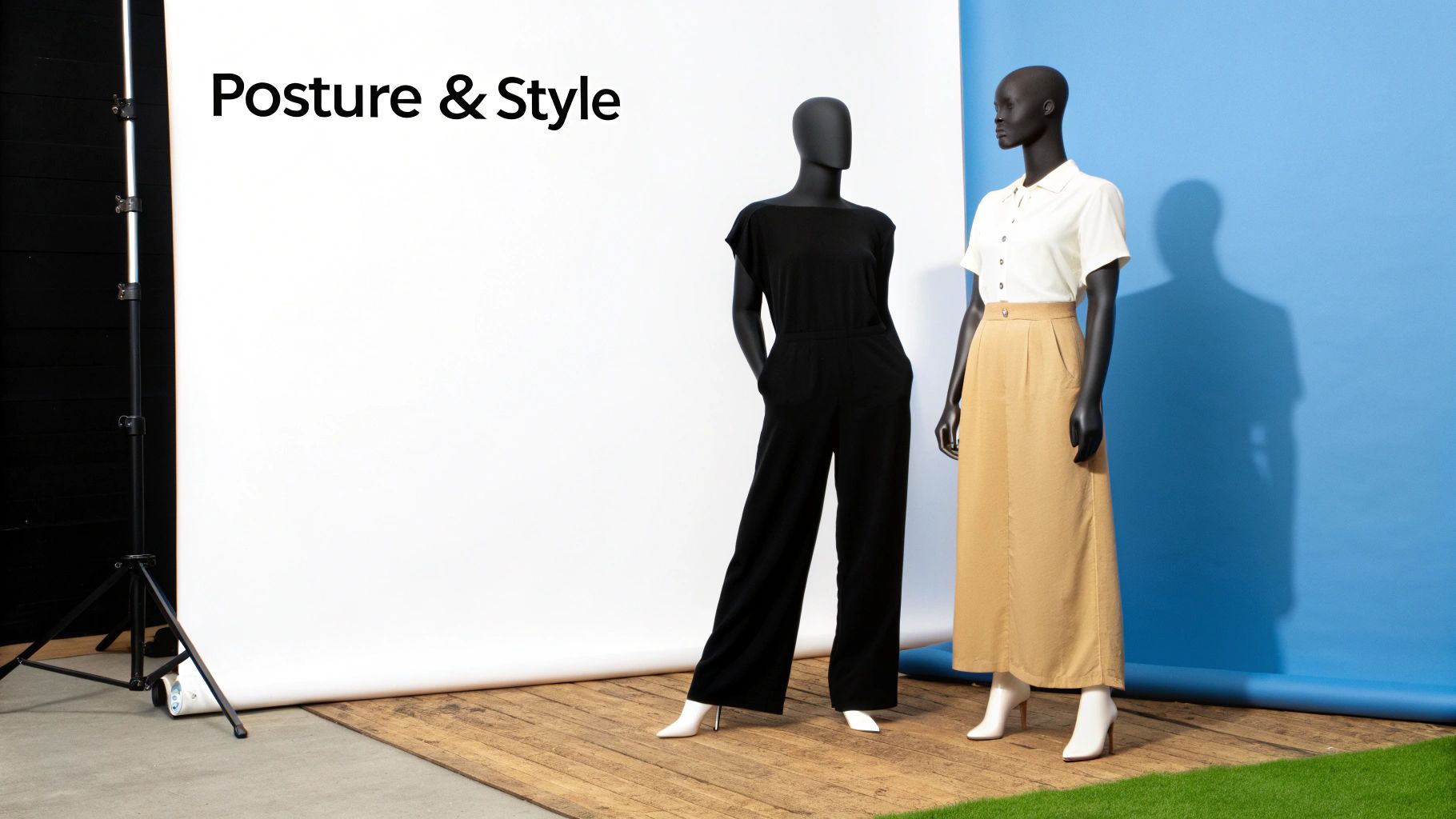
While building muscle is the long game, you can get a serious confidence boost right now just by tweaking your style and posture. This isn't about hiding your body—it's about dressing to celebrate your unique shape while all your hard work in the gym starts to pay off.
Feeling self-conscious is completely normal, especially with social media making us second-guess everything. A 2021 survey actually found that 68% of young women felt insecure about their hip dips. Mental health experts are clear that these pressures can really chip away at self-esteem.
Learning to embrace your body is a journey, and these simple tips are here to help you feel amazing along the way.
Dress to Flatter Your Shape
Finding the right clothes can instantly create a smoother silhouette that plays up your best curves. The trick is to choose fabrics and cuts that drape over your hips instead of clinging to every indentation.
Here are a few wardrobe hacks that work wonders:
- High-Waisted Wide-Leg Trousers: These are a total game-changer. The high waist hits you at your narrowest point, and the fabric just flows straight down from your hips, creating one long, beautiful line.
- A-Line Skirts and Dresses: This classic shape flares out from the waist, skimming right over the hips and thighs. It gives you that balanced, feminine silhouette without putting a spotlight on the dip area.
- Structured Fabrics: Think thick denim, corduroy, or even a heavy knit. These materials hold their own shape instead of clinging, giving you a bit of built-in smoothing.
Never underestimate the power of a killer outfit. When you feel incredible in what you're wearing, that confidence is what everyone sees—not a specific body part.
The Power of Posture
Seriously, how you carry yourself changes everything. Slouching can make indentations more obvious and your middle look softer. Standing tall creates a stronger, more confident frame in seconds.
Think about lifting everything up from your core. Pull your shoulders back and down, gently draw your belly button toward your spine, and keep your chin level. This simple alignment doesn't just make you look more put-together; it properly supports your spine and pelvis.
If you struggle with this, looking into how to fix anterior pelvic tilt can make a huge difference in your overall silhouette and how you stand.
When Exercise Isn't Enough: Cosmetic Options for Hip Dips
While hitting the gym and eating well are fantastic for building muscle and feeling strong, some people still feel self-conscious about their hip dips. If that’s you, you might be curious about cosmetic procedures that can add volume where you want it.
This isn’t about pushing you one way or the other. It’s a huge decision with real costs, recovery time, and risks involved. Let's just break down the options without the sales pitch so you know what's out there. The two main paths are fat grafting and dermal fillers, which both work by physically filling in that indentation.
Fat Grafting vs. Fillers
Fat grafting is a surgical procedure, often done as part of a Brazilian Butt Lift (BBL). A surgeon uses liposuction to take fat from one part of your body (like your stomach or thighs), purifies it, and then injects it into your hip area. It’s a way to reshape your silhouette using your body's own tissue.
Dermal fillers like Sculptra are the non-surgical route. Sculptra is a bit different from your typical filler—it’s made of poly-L-lactic acid, which kicks your body into producing more of its own collagen over several months. This means you’ll need a few sessions to gradually build up the volume.
It's easy to get swept up in the hype. The global market for non-invasive body contouring is massive, but promises don't always equal results. Studies have shown that improvements can be temporary and are only seen in less than half of patients.
What to Know Before You Decide
Both of these options are serious medical procedures with big things to consider. Fat grafting is major surgery, and that means downtime and all the risks that come with going under. If you're thinking about a large-volume transfer, it's absolutely critical to understand the risks associated with a Brazilian Butt Lift (BBL).
Fillers are less invasive, but the cost adds up fast. The results aren't permanent, so you're looking at ongoing maintenance appointments to keep the look.
No matter what, the most important step you can take is scheduling a consultation with a board-certified plastic surgeon. They can give you the real story on what’s possible for your body, what’s realistic, and what’s safe.
Your Top Questions, Answered
Let’s get real about some of the questions that come up time and time again. Sorting out the facts from the fiction is half the battle when it comes to staying consistent and happy with your progress.
How Long Until I See Results?
This is always the first question, and the honest answer is: it depends. Building enough muscle to see a real change doesn’t happen overnight.
If you’re sticking to the plan and eating right, you’ll probably start feeling stronger and more solid in a few weeks. But visible changes? Those usually start showing up around the 2-4 month mark. Your genetics, how hard you push in your workouts, and what you’re eating all have a say in the timeline. The real key is patience and consistency.
Can Certain Foods Make Hip Dips Worse?
No. A single food isn't going to cause or worsen hip dips—that’s just your bone structure.
But your overall diet does matter. A diet full of processed junk and sugar can lead to more body fat, and depending on where you store it, this could make your dips seem more prominent. On the flip side, a diet packed with protein and whole foods gives your muscles the fuel they need to grow, which helps build up that rounder, fuller shape.
Key Takeaway: Your results come down to consistency. Show up for your workouts, give your body the right fuel, and learn to trust the process. Real change is a marathon, not a sprint.
Do I Need to Eat More to Build Muscle?
Yes, if you're serious about building your glutes, you need to give your body the building blocks to do it. That means energy, in the form of calories.
A small calorie surplus—eating just a bit more than you burn—is what fuels muscle repair and growth. Aiming for an extra 200-300 calories a day is a solid goal. Make sure those extra calories come from high-quality sources, especially protein. It’s a non-negotiable part of the equation if you really want to change the appearance of hip dips.
Ready to give your body the powerful, clean fuel it needs to build stronger glutes? Bold Buns creates science-backed creatine formulas designed specifically for women to help you sculpt, tone, and feel incredible. Learn more at https://tryboldbuns.com.